Loading…

Harmony · INVESTOR DECK
Several coding agents. One workspace that shows what each is doing.
A local workspace where the coding agents you already pay for run side by side, share a task board, and hand work off durably.
Built for a fleet of agents, not one chat window at a time.
01 / 12 · Investor Deck
August 2026 · ideharmony.com
THE PROBLEM
The agents got fast. Coordinating them did not.
Every coding agent runs its own session with its own picture of the repository. Point two at the same codebase and they edit the same file from different assumptions. The engineer ends up as the messenger between chat windows.
Context dies when a session ends, so the next run starts by re-explaining the codebase. Every additional agent makes this worse, not better.
The bottleneck moved from writing code to conducting it.
02 / 12 · The Problem

WHY NOW
The second agent is what creates the problem.
Running one coding agent is a workflow. An engineer can now install several from different vendors on the same machine, Claude Code, Codex, Cursor, Grok, Gemini among them, and each will hold a task long enough that starting another one while the first works is the obvious move.
That is what changed. Once there are two, the missing product is not a better model. It is the place the two of them meet: one task board, a handoff that survives a restart, and one view of who is doing what.
One agent needs a prompt. Several need a workspace.
03 / 12 · Why Now

THE PRODUCT
Available todayThe consequence: one local workspace for the fleet
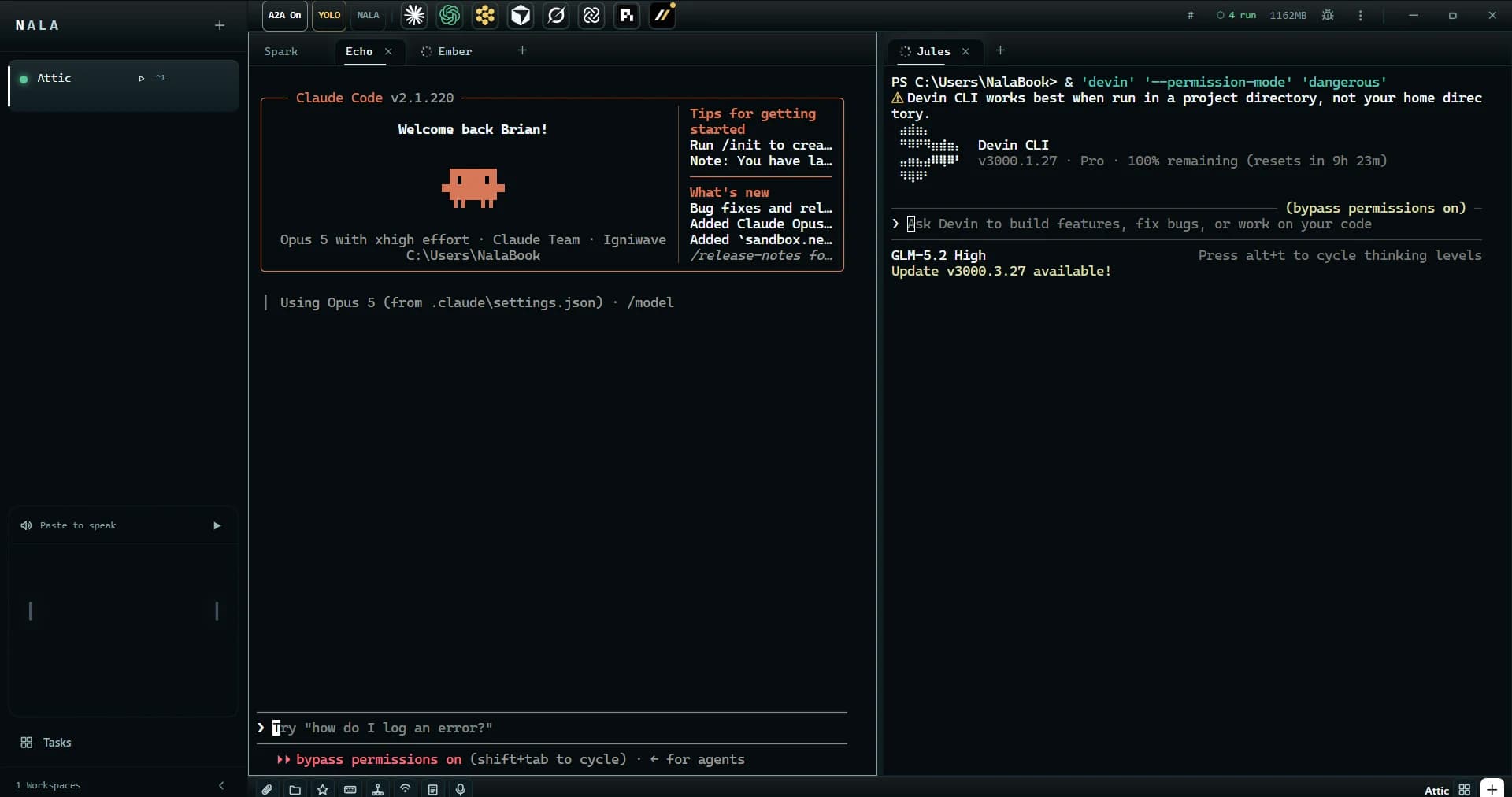
Harmony connects the coding agents engineers already pay for and runs them as one fleet: one task board, durable sessions, explicit approvals.
Close the app. Reopen. Your agents are still working. Quit Harmony with sessions running in the background. Open it again and land where you left off: agents still running, tabs and terminal history still there.
The place several agents meet: one board, one history, one machine.
04 / 12 · The Product
HOW IT WORKS
Orchestration with a paper trail
Work is broken into tasks an agent claims, so a claimed task is visibly owned and claimed tasks reduce double-starts when the roster is authoritative.
Agents hand off through durable messages that survive a restart, acknowledged end to end. Parallel work uses separate git worktrees so edits do not collide on one shared index.
No agent spawns another without your signature, and every approval is single use.
Ownership, handoff, and approval are product surfaces, not chat etiquette.
05 / 12 · How It Works
THE MARKET
Start where the pain already is
The beachhead is engineers already paying for two or three coding agents and losing hours reconciling them. They do not need convincing that agents work. They need the layer that makes agents work together.
From there the surface widens: any team that adopts agents inherits the same coordination problem, and the orchestration layer sits above every model provider at once.
Demand tracks agent adoption: more agents, more reconciliation work.
TO FILL IN — Market sizing: a bottom-up count of engineers running multiple coding agents, their spend per seat, and the team-level expansion. Fill from your own research before sending.
06 / 12 · The Market

THE LANDSCAPE
Editors bolted agents in. Harmony starts from the fleet.
AI editors kept the file at the centre and parked agents in a chat panel. Agent CLIs run one session at a time with no shared task state. Harmony inverts both: the fleet, the board, and the handoff are first-class.
WHERE AGENTS LIVE TODAY
- A text editor with a chat panel; the file stays the centre
- One session at a time, no shared task board between agents
- Context dies when the window closes
- Often tied to one model, one editor, or one vendor
Harmony
- The fleet is the centre: tasks, terminals, and approvals are first-class
- Agents share a task board and hand work off through durable messages
- Close the app. Reopen. Your agents are still working.
- Provider-neutral tabs: Claude, Codex, Cursor, Grok, Gemini, Devin, and others you already pay for
Run Claude, Codex, Cursor, Grok, and Gemini side by side in one workspace. They share one task board and hand work to each other, and you see honest status wherever Harmony can observe what an agent is doing.
07 / 12 · The Landscape
THE BOUNDARY
Your provider keys never touch our servers
Bring-your-own keys travel from your machine straight to the provider: never stored, never proxied, never logged, never in a support bundle.
We do not sign in to providers for you, and a provider subscription cannot be routed through us. That is an architectural line, not a policy promise.
Local-first is the security model, not a feature flag.
08 / 12 · The Boundary

BUSINESS MODEL
Built, not switched onFree local app. Optional gateway on top.
The desktop app and terminal agent are free and stay free. Harmony does not resell inference, so the free product never has to be crippled to survive.
For engineers who would rather not manage keys, a metered gateway is built and deliberately switched off until the economics and the terms have been checked. Distribution first, monetization second.
We do not tax your tokens to fund the workspace.
09 / 12 · Business Model

TRACTION
Real software you can install today
A Windows build is published and downloadable now, through a one-line installer that verifies the exact SHA-256 before anything runs. Builds are currently unsigned, so the OS warns on first install; the checksum is published with each release.
The orchestration layer is shipping code: task claiming, durable handoffs, single-use approvals, an MCP harness with 30+ tools, and 40+ built-in agent roles.
Diligence starts with install, not a slide metric we do not have.
TO FILL IN — Downloads to date, weekly active installs, and design-partner conversations. Fill from the admin analytics before sending.
10 / 12 · Traction

ROADMAP
PlannedCross-platform, then depth
Next is macOS and Linux through the same digest-verified pipeline Windows already uses, plus code signing so installs stop triggering OS warnings.
Then depth in the orchestration layer: richer departments, longer-running work, tighter cost control. Hosted workspaces stay research until the credential and spend questions have real answers.
Ship platforms and signing before inventing cloud claims.
11 / 12 · Roadmap

THE ASK
Point it at a repository you know
The fastest diligence is to install Harmony, connect two agents, and watch them share a task board instead of a chat window. If the coordination holds, the rest of this deck is context, not proof.
It is built by a founder who runs it daily against real repositories, so the feedback loop is measured in hours, not roadmap quarters.
Try the product. The deck is the map, not the proof.
TO FILL IN — The ask itself: raise amount and use of funds, or the design-partner intro you want from this investor. Blank on purpose; a vague ask is worse than none.
12 / 12 · The Ask
Harmony · Run AI coding agents side by side in one local workspace
Ctrl/Cmd+P saves this deck as a PDF